Meena Alexander + Monika Weiss + Buzz Spector (2015)
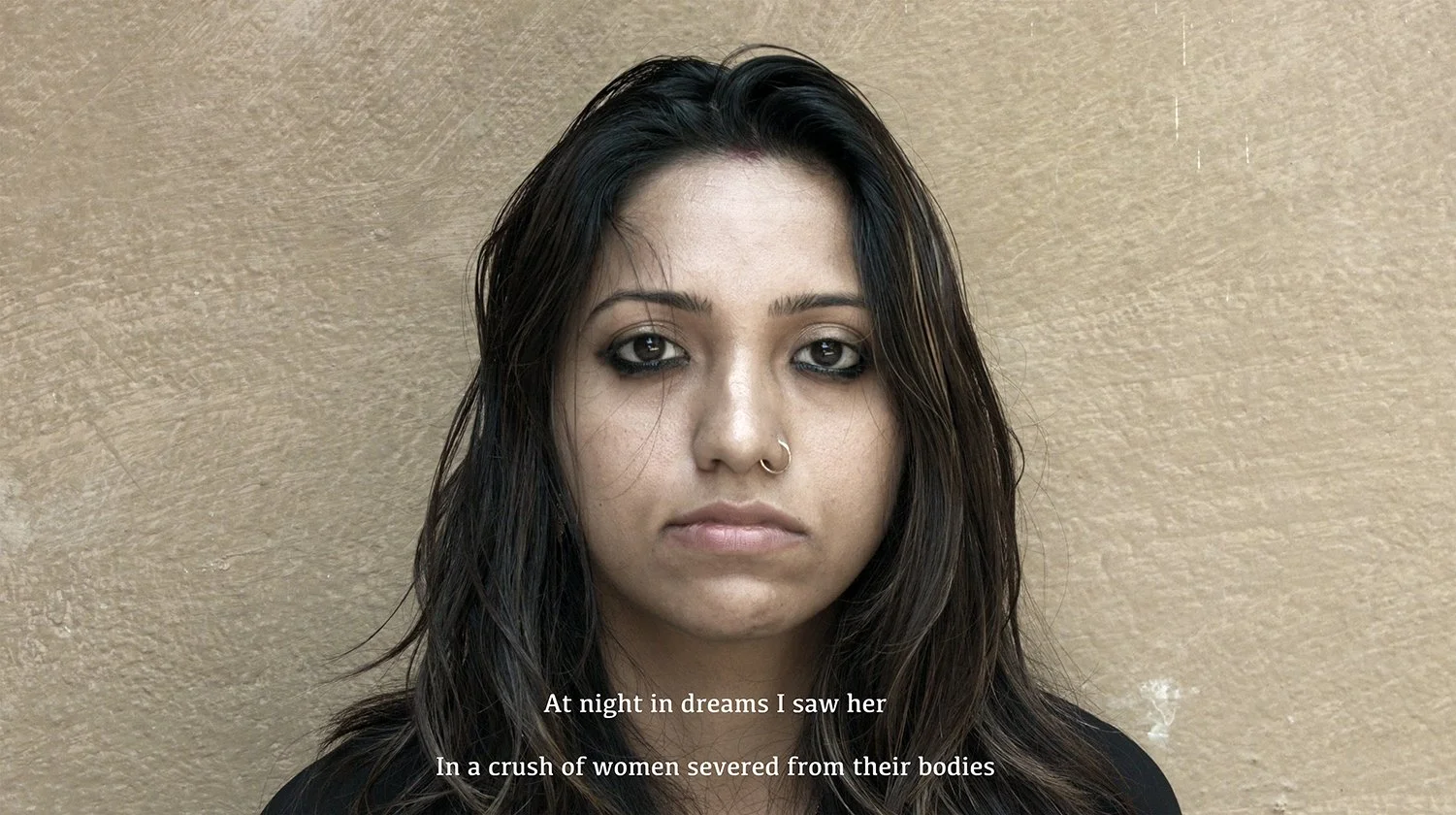
Monika Weiss, Two Laments (19 Cantos) - Canto 4, 2015, still from silent film, duration 6 minutes 45 seconds.
TWO LAMENTS
MEENA ALEXANDER & MONIKA WEISS IN CONVERSATION
Moderated by Buzz Spector
2015
Published in Monika Weiss: Nirbhaya. Orońsko: Centre of Polish Sculpture Press, 2021
Polish version below/Wersja po polsku poniżej
INTRODUCTION
Canto 4 is part of Monika Weiss’ Two Laments (19 Cantos), a series of projected film and sound works shown in Orońsko in Spring 2021. Canto 4 includes the poem, Moksha, by the late Indian poet Meena Alexander, which she dedicated to Nirbhaya. The original aspiration for the transcribed dialogue between Weiss and Alexander was to publish a book incorporating words and examples from their parallel arts. The subsequent realization of Nirbhaya monument, as well as this monograph, were not yet a factor in that 2015 conversation, but the ideas about trauma, healing, and wrath which were then spoken foreshadow the monumental project that Weiss has since developed for Orońsko and for the world. Special thanks to historian David Lelyveld, Meena Alexander’s husband, for permission to publish these excerpts from the conversation.
BUZZ SPECTOR:
I come to this conversation with the fresh experience of seeing four of Monika’s 19 Cantos from the ongoing series. The tone of the work I saw, its langua, is of a peculiar combination of sorrow, wrath, and desire. Perhaps some framing of its iconography is useful for us to begin.
MONIKA WEISS:
In October 2014, I was invited by Amit Mukhopadhyay, a curator in the public sphere based in Kolkata, India, to create a new project in relation to the city of Delhi. I conducted intense and intuitive research into the history of the city while continuing my work on lament in relationship to postmemory.[1] I focused on two sites of trauma: the recent brutal gang rape of Jyoti Singh[2] (posthumously named Nirbhaya[3]) which took place on a moving bus, on December 16, 2012, and the colonial residue of India Gate memorial[4], whose foundation was laid on February 10, 1921 by the Imperial War Graves Commission[5]. Two Laments (19 Cantos)[6] became a series of 19 short experimental film projections considering two kinds of trauma: personal and public, exploring how narratives of war and gender-based violence are selectively memorialized and actively erased within social and political consciousness. In court transcripts of the gang rape trial[7], I found a statement by one of the perpetrators who remembered seeing a red ribbon coming out from the woman’s body, which upon further investigation revealed itself to be her intestines. 19 Cantos begins with a prelude composed of silent text, which I wrote while in India, set in bold white font against a black background. Composed in stanzas of two lines each, the text evokes the voice of Nirbhaya, as if she was resurrected to appear as a witness. The text is repeated by different female voices speaking in various languages throughout the 19 Cantos. It begins with the statement, “This is my ribbon/ taken out of my body by you.” The 2012 gang rape lasted almost two hours as the bus moved through the city of Delhi, and this, I felt, implicated the entire city and, by extension, any city around the world. Jyoti Singh’s body was taken inside out in a horrific and transgressive culmination of the act of the rape itself. This fact became a catalyst for the entire project of Two Laments (19 Cantos). My 19 film projections show slow, repetitive movements of silent lamentation performed by young women volunteers whom I choreographed and filmed in New Delhi and also in New York. In many of the short films, the red ribbon appears as a veil that my performers hold close to their abdomen. In Canto 3[8] the veil poetically enshrouds the aerial view of Old Delhi, which becomes a meta-city, standing for all cities bearing traces of historical trauma. I wanted for the memory of this horrific rape to have a kind of gravity corresponding with the grand architecture of India Gate, which is a triumphant arch. The work couldn’t be monolithic, it had to be fragmented, pulsating, and circular in the way it conceives time. To put this work in the context of desire is interesting and unexpected. Perhaps desire appears as a form of beauty — which I found within the land, within the body. The map of the old city of Delhi, as it is shown in Canto 3, evokes an impossible-to-conceive loss of old cultures and lives, which is difficult to describe in words.
BUZZ SPECTOR:
You are recalling both the inception of your process and the trauma, which was catalytic for your work to occur. The trauma is vivid and, like all trauma, it disturbs language.
MEENA ALEXANDER:
Having just seen the piece again, I was very struck by how the slowness of the body and the slowness of the movements in Monika’s Cantos is iconic in the way that, imaginatively, we have to embody something in order to make
art. When I work on a poem, I feel like it is being immersed in an emotion and then it has to irradiate me. Living in that way, it can become difficult to cross the street or do ordinary things. You asked me earlier, Buzz, about time in Monika’s work. I was very struck by it. It felt just right to me. There is a meditative embodiment of what lines or images cannot spell out: the impalpable. This is what I try to approach in my poetry. I think poetry is really an art of silence because the most that the words can do is to pitch you towards what, in the end, cannot be spoken, and might only dimly be embodied. We face the horizon of what cannot be named. I think this is where the link to trauma is powerful because, like ecstatic knowledge, it pushes you to a break in the grammar of the everyday. I used to live in Delhi when I was 23. It took me two years to compose Moksha[9], which I started when I was riding a train from Parma to Modena. I glanced out the window and saw somebody who looked exactly like my sister-in-law, who had died several years earlier of breast cancer. It was completely uncanny. I wrote a few lines and stopped. Then this awful rape in Delhi happened. It was so shocking, but in a strange way not completely surprising insofar as something can be unsurprising and, at the same time, utterly shocking. I know the Munirka bus stop because I used to go there when I was at Jawaharlal Nehru University[10]. It was dreadfully hard to board a bus in those days when I was young and constantly being pinched and prodded. Delhi is a city that was built layer upon layer. There are several ancient cities beneath contemporary Delhi. When I look at India Gate, which is where all of the protests happened, I also think of the destruction the city suffered. After the great uprisings of 1857, the British raised the old city of Delhi[11]. In my 2013 book Birthplace with Buried Stones[12] I have a cycle of poems inspired by Mirza Ghalib, who wrote an extraordinary memoir in Persian, Dastanbuy, composed in the aftermath of the destruction of the city in 1857.[13]
BUZZ SPECTOR:
Therefore, does the map, which appears in Monika’s Canto 3, precede India Gate?
MONIKA WEISS:
Yes, I found this map-like aerial representational drawing titled The City of Delhi Before the Siege published on page 52 of the January 16, 1858 edition of The Illustrated London News[14]. In Canto 3, a performer appears as if she was lying down on this map. We see the city right before the siege by the British in 1857. The performer moves very slowly, dressed in a long black robe, which gradually becomes soiled by the dirt of the ground, as if stained by the city itself. At some point, she becomes two women overlapping and merging with each other. Ultimately, by the end of the projection, she and her double disappear, leaving headscarves laid over the surface of the city. I created a kind of split into two at the heart of the map. Because the map is equal to the size of the projected image, the projection also seems to be split. Additionally, the scale of the women’s bodies is equal to the scale of the city. This is significant to me because the city, any city, is therefore doubly marked and implicated.
MEENA ALEXANDER:
I think the rape of a woman and the rape of a city are important in your work. In Urdu, there is a form of lament for a city called marsiya [15]. What you are doing with the women in your Cantos is very beautiful because of the very slow movement. This approach feels right to me. Maybe this is the way we make sense of what, in the end, is so violent and so absurd. The work has to be very slow in movement and musical, since music exists in time and, unlike sculpture or a book, it does not occupy space. When your piece is over it vanishes, am I right?
MONIKA WEISS:
Yes, it vanishes because it is like an act of mourning. But it also returns, like echo. The oldest known forms of archaic lament were conceived as an imaginary dialogue between a passerby and a tomb, which was ultimately an impossible communication with someone who is dead[16]. This archaic lament later developed into musical and poetic forms of refrain and incantation. The specific technique of montage with which I construct my projections and sonic compositions involves the reversal and layering of images and sounds to create a space of circular time akin to this method of incantation. I liked when you said that poetry is about that which cannot be shown. I think art also deals with things that cannot be shown. At least in my work they cannot. Time and again, I am drawn toward working with the most difficult subjects and traumatic sites, fragments of memory, and historically forgotten or erased events. However, one cannot show or “speak” those sites or events. As a result, my work seems to reside in a liminal space between showing and not showing, speaking and not speaking.
MEENA ALEXANDER:
I think the unspoken question is where you put your own body as you face something that is too terrible to be borne. How are you implicated in it and what is the right and delicate place for you? You can’t appropriate it; it is not yours.
You are a witness, but what does this mean? I wrote a whole cycle of poems, Letters to Gandhi[17] set in Gujarat in 2002, after the violence perpetrated against Muslims[18]. I visited the relief camps with a friend who was collecting eyewitness testimony for the People’s Union for Democratic Rights[19]. I sent the poems to a friend in Delhi, who then forwarded them to his friend working for The Hindu. The newspaper carried the whole cycle, which was quite unusual for it. I can’t forget how the editor wrote to me about the great beauty of the poems, and how it brought to mind what people who are suspicious of art think: how can you make a thing of beauty out of such terror? I wrote back to him that it seemed to me that the task of beauty was to return us, in some measure of tenderness, to the earth from which we were cut away, precisely by the extremity of violence. I then included this exchange in an essay entitled “Fragile Places,” which is a reflection on making art in a time of violence. This essay is included in my book of essays, Poetics of Dislocation[20]. Art does have a job to do: it involves working with beauty.
MONIKA WEISS:
The city understood as a public space protects its public memory and, in a way, it doesn’t want to be “polluted” by traces of crimes against the bodies of women. A woman’s rape is often culturally associated with victimhood and actively erased from cultural memory. The body of a woman in the public sphere is the body of flâneuse. In Canto 3, Nirbhaya’s body becomes the size of an entire city. I am altering the scale of her body to make a point.
MEENA ALEXANDER:
This is precisely on target. This is what you have to do in order to make sense of what is happening. The scales have to be altered. Working with the poem was an experi- ence of temporality that I had to resolve. I began writing the poem in Parma and finished it two years later in Shimla because I felt it had to be finished in India. I also needed the distance in time and, in that sense, it was about musicality. The turning point in my poem is when I see the two women and when I hear them sing.
MONIKA WEISS:
This is such an important moment in your poem, when you state that you see and hear two women. This stanza became the reason for me to include Moksha in Canto 4. This piece is silent. We see a close-up of a woman standing against a bare wall, facing us with her eyes closed. She slowly lifts her head to the point of the limits of the gesture, and then returns and bows all the way down until she almost disappears from the frame. This movement repeats several times throughout Canto 4.Twice during the 4 minutes of the video the protagonist opens her eyes and stares directly at us. I was interested in creating a specific counterpoint between each two lines of Meena’s poem — which appear at the bottom of the projected image as if they were a subtext in a film — and the gradual motion of the woman’s head. At some point only one, partial sentence appears, taken out of the context of the rest of the poem, “before all our tongues began.” After that line appears in the video, there is a long pause. Yesterday, when you read Moksha as part of a public reading in The New York Public Library, it was beautiful, but it felt much faster than how I heard it in my imagination. “Before all our tongues began” could be the beginning of a sentence or an end. To me “before all our tongues began” means we are in a liminal place where this particular rape occurred. This is a particular city and a specific body, which stand for all rapes and all cities. In Two Laments the site of trauma, Nirbhaya’s body, is performed and inhabited by many women, symbolically reverting our gaze. In Canto 4, her body places us in the speechless, within the “before the tongues began” space. We are in the space of lament because we cannot utter the horrific.
MEENA ALEXANDER:
Those two lines came on a separate page in my notebook, because they were so important. They took me back to emotions I’d had when I was in my twenties in Delhi, to a rose garden there. It is a city of amazing, gorgeous flowers. I think there is something in the way in which extreme violence, as well as the specificity of what occurred to Jyoti Singh, has to dissolve into something else that is more of a cypher. Perhaps this relates to what you are doing in your work. I think this is the task of the work of art, and it is a very delicate, intense sort of activity. You are negotiating between fierce injustice, the horror of violation, and the ethics of beauty. That is why I love what you did with the slowness of her gestures, and of composition. Toward the end of Canto 4, she is looking at us. There is another thing that she is seeing, which is perhaps desire. It is believed that fifty years have to pass — a whole generation or perhaps more — before communities are able to face up to violence perpetrated on a large scale. It was the case in some ways with the bloodshed in the aftermath of the Partition of India[21]. Sometimes we feel called upon to make a certain work of art. I have not lived in Germany. I was only in Palestine for a little over a month. You have not lived in India before. That is not what our work is about. I think each artist has a particular DNA and a particular palm print that structures the work of art. This makes the work unique. And this also allows you and I to respond to each other’s work in intimate ways. In 2005, I wrote a poem called Aletheia[22] inspired by your sculpture and performance piece, Lethe Room. What fascinates me about your work is the way you use the body, which I admire and find moving. How you employ the body allows you to touch the place that is behind what we are consciously aware of. Perhaps this is also what I try for in my poems.
BUZZ SPECTOR:
This is what interests me. The pacing of your poem is apportioned by Monika into two-line bits. Each bit was on screen for a long while. I am focusing here on the difference between the speed of Monika’s movements as enacted on camera and the speed we assume such gestures occupy in real space, in real time. Meena, I assume you would read your poem with a crisp pronunciation? You wouldn’t linger over each word to the length of time that those stanzas appear now in Monika’s Canto 4.
MEENA ALEXANDER:
Yes, it felt as if Monika returned it to a kind of music.
BUZZ SPECTOR:
Nothing is being spoken. We are reading. The words do not become empty glyphs in a scene whose action is only that of the woman. We read again and again. We read each two lines against their attachment to that face. The astonishing renewal is that each stanza of your poem in turn allows the question, “is this that woman?” to be asked again. She shifts from being your sister-in-law to being Nirbhaya, then becomes both.
MEENA ALEXANDER:
During our previous conversation at Maribelle, you asked me something, Monika. We both spoke about doubleness in our work. I think this is very important in your composition. Later, after our meeting, I thought about it on the subway. Two things came to me. The sage Valmiki, standing at the edge of a river watched two mating birds. The male was struck by an arrow and killed. The desolate bird who survived cried out so piteously that the poet’s soul filled with emotion, and he was moved to compose the epic Ramayana.[23] The other thought also involves two birds, and this also came to me in the speeding subway. It is the notion of sakshi,[24] that we find in the Upanishads.[25] Two birds are on a tree; one is enjoying the taste of the ripe fruit on the tree, the other watches silently. The second bird is the witnessing consciousness. We need both selves, both birds, in life and in art. Think of Valmiki, that is, the way the poet writes. There are two birds and one is shot, then out of the emotion of that grief comes the poem. There are always two, at least in certain strands of ancient classical Sanskrit aesthetics. Not one, but two.
BUZZ SPECTOR:
It is very important that one becomes two, or that there is one woman seen twice. The one does not stay one. Two images of one person can’t be sustained imaginatively, even as one person seen twice, without some further act, some hallucination one conjures up as an implement to create an impossible separation. We are all more than one. The image becomes one and the other; the one with the other, the one as the other. The encouragement we get happens through your armature, which is itself double. In Canto 3 the page is double, so that the inscription repeats itself, impossibly, though the map itself is continuous. But the map has the fundamental property of the book — that gutter, that seam where two become one. Two become one in the book, one becomes two in the body, and then there is the speed of movement which corresponds to the turning of a page. You even provide us with the black scarf and the reds scarf, as pages.
MEENA ALEXANDER:
And so that in Canto 4, each stanza becomes a page that turns. The entire space is given to the couplet. Both you and I have elegiac imaginations. “We have poetry so we do not die of history”, I wrote somewhere[26]. You and I face the muse of lamentation. There are artists and poets who are not like us, who have a very different way of inhabiting the present. Both you and I have memory taking the front space. Maybe this is why doubleness comes through as the mnemonic posture.
The above are excerpts from a transcribed conversation between artist Monika Weiss and late poet Meena Alexander that was moderated by Buzz Spector. The recorded conversations continued intermittently from 2015–2018, until Alexander’s untimely death in Fall 2018.
NOTES
[1] Marianne Hirsch’s notion of “postmemory” describes “the relationship of the second generation to powerful, often traumatic, experiences that preceded their births but that were nevertheless transmitted to them so deeply as to seem to constitute memories in their own right.” From “The Generation of Postmemory,” Poetics Today, 29:1 (2008), p. 103.
[2] 23-year-old Jyoti Singh and her friend Awindra Pratap Pandey were assaulted on a moving bus on the night of December 16, 2012 in Munirka, New Delhi. Jyoti Singh was brutally gang raped by six men after her friend was beaten unconscious, and she later died of her wounds. See “Delhi gang-rape victim dies in hospital in Singapore,” BBC News (December 29, 2012).
[3] Nirbhaya, meaning “Fearless” in Hindi.
[4] India Gate is a monument constructed to commemorate 70,000 Indian soldiers who were killed in the First World War. The foundation stone was laid in 1917 and the memorial was inaugurated in 1931.
[5] The Commonwealth War Graves Commission was established by a royal charter 1917 to “sustain the commemoration of the war dead, which after WWII numbered 1.7 million, in cemeteries and on memorials in some 150 countries.” The Commission operates upon the principle that “each of the dead should be commemorated individually by name either on the headstone on the grave or by an inscription on a memorial; that the headstones and memorials should be permanent; that the headstones should be uniform; that there should be no distinction made on account of military or civil rank, race or creed.” Peter J Francis, “Commonwealth War Graves Commission,” The Oxford Companion to Military History, edited by Richard Holmes, Charles Singleton and Spencer Jones, Oxford: Oxford University Press, 2001.
[6]Two Laments (19 Cantos) by Monika Weiss: Film, sound, drawing and text work developed during an artist residency at the Sanskriti Foundation in New Delhi, 2015. Two Laments were inspired by ‘Treny’ (19 lamentations) by the 16-century Polish poet Jan Kochanowski on his daughter’s death. This work is dedicated to Jyoti Singh.
[7] In court transcripts of the trial I found a statement by one of the perpetrators, who remembered seeing a red ribbon coming from her body.
[8] Canto 3 from Two Laments (19 Cantos) depicts the body of a woman performing lament superimposed upon the map of Old Delhi. A red ribbon is pulled from her body and poetically enshrouds Delhi, which becomes a meta-city, standing for all cities bearing traces of historical trauma.
[9] Meena Alexander, “Moksha,” The Hindu (December 7, 2014). For more information on The Hindu newspaper, visit http://www.thehindu.com/.
[10] Jawaharlal Nehru University (founded in 1969) is a public University in New Delhi. For more information regarding the foundation of the university and its vision, visit http://www.jnu.ac.in.
[11] On May 10, 1857, “three hundred mutinous sepoys [Indian infantry] and cavalrymen from Meerut rode into Delhi, massacred every Christian man, woman and child they could find in the city, and declared Zafar [the last Mughal emperor] to be their leader.” The British blockaded Delhi until it was on the brink of starvation and on September 14th, the British took the city, “sacking and looting the Mughal capital and massacring great swathes of the population. In one muhalla [neighborhood] alone, Kucha Chelan, some 1,400 citizens of Delhi were cut down. ‘The orders went out to shoot every soul,’ recorded Edward Vibart, a nineteen-year-old British officer.” Wiliam Darlymple, The Last Mughal: The Fall of a Dynasty, Delhi, 1857, New York: Alfred A. Knopf, 2007, pp. 3–4.
[12] Meena Alexander, Birthplace with Buried Stones, Evanston: Northwestern University Press, 2013.
[13] “The city of Delhi was emptied of its rulers and peopled instead with creatures of the Lord who acknowledged no lord — as if it were a garden without a gardener, and full of fruitless trees,” Mirza Asadullah Khan Ghalib, Dastanbuy: A Diary of the Indian Revolt of 1857, Translated by Khwaja Ahmad Faruqi, New York: Asia Publishing House, 1970, p. 33.
[14] “The City of Delhi Before the Siege,” The Illustrated London News, January 16, 1858, p. 52. The Illustrated London News was a weekly illustrated news magazine that reported on international events. Published only four months after the Siege of Delhi ended, the image shows a picturesque city that had been recently destroyed.
[15] “The term marsiya (elegy) derives from the Arabic risa, praising (the dead) in a funeral oration, weeping and wailing over the deceased. A marsiya is a poem about the good qualities of a deceased person, recited to express sorrow at his death; a poem to commemorate a pathetic event.” The marsiya developed in the Deccan states of India as a form of Persian/indigenous poetry and flourished throughout the sixteenth and seventeenth centuries. The form spread to North India, where marsiyas were composed in Urdu, in addition to Persian. Marsiya is a ritual performance of mourning, an elegiac musical form as well as a literary genre. Madhu Trivedi, “Invoking Sorrow: Marsiya in North India,” Traditions in Motion: Religion and Society in History, edited by Satish Saberwal and Supriya Varma, Oxford: Oxford University Press, 2005, pp. 127–131.
[16] For further reading on Lament see Lament: Studies in the Ancient Mediterranean and Beyond, edited by Ann Suter, Oxford: Oxford University Press, 2008, and Margaret Alexiou, The Ritual Lament in Greek Tradition, Lanham: Rowman & Littlefield Publishers, Inc., 2002.
[17] Meena Alexander, “Letters to Gandhi,” The Hindu (July 6, 2003).
[18] On February 28, 2002 in Gujarat, India, an anti-Muslim pogrom began that lasted for three days. Muslim homes and religious structures were destroyed, Muslim businesses were boycotted and Muslims were murdered. After three days, 150,000 people had been forced out of their homes and more than 1,000 people lay dead, the majority of whom were Muslim. Several mass killings and other instances of violence occurred in the following months. The violence was enacted through a “script” of “Hindu awakening,” as purported in media sources. Anthropologist Ghassem-Fachandi argues: “the effervescent experience of ‘Hindu awakening’ is a veritable dissolution and rebirth into a social collective held together by negativity. It awakens destructive impulses, a nihilist guarantee of group cohesion, that enable an abreaction in an orchestrated environment, one often termed ‘riots,’ which, while carrying many incalculable risks, appears nonetheless micromanaged and controlled.” From Pogrom in Gujarat: Hindu Nationalism and Anti-Muslim Violence in India, Princeton/Oxford: Princeton University Press, 2012, pp. 259–260.
[19] The People’s Union for Democratic Rights is a “civil liberties and democratic rights organization based in Delhi, India.” For more information visit http://www.pudr.org.
[20] Meena Alexander, Poetics of Dislocation, Ann Arbor: University of Michigan Press, 2009.
[21] “On ‘Direct Action Day,’ [the day the Muslim League backed out of negotiations with Congress] 16 August 1946, violence broke out between Hindus and Muslims in Kolkata. Several thousand people were killed in four days. From here, the violence spread, one way and then the other, to engulf many parts of northern India by March 1947 …A British general wrote of the fierceness of the attacks and the rapidity with which they spread from the cities to the countryside. In the cities of Rawalpindi and Multan, ‘attacks were fiercer, more sudden, and more savage than ever. In the rural areas attacks were launched by large mobs of Muslim peasants who banded together from several hamlets and villages to destroy and loot Sikh and Hindu shops and houses in their area. In some areas savagery was carried to an extreme degree and men, women and children were hacked or beaten to death, if not burned in their houses’…Many people took their own lives, or those of their family members, rather than surrendering to bondage and dishonor. The collective suicide of ninety or more women and children in the village of Thoa Khalsa is now the best known of these incidents.” Gyanendra Pandey, Remembering Partition: Violence, Nationalism and History in India, Cambridge: Cambridge University Press, 2001, pp. 23–24.
[22] Meena Alexander, “Aletheia,” Quickly Changing River: Poems, Evanston: Northwestern University Press, 2008, p. 28.
[23] “The Vālmīki’s Rāmāyaṇa is an epic poem of some 50,000 lines retelling in Sanskrit verse the career of Rama, a legendary prince of the ancient kingdom of Kosala in the eastern portion of north central India.” There is much disagreement concerning the original date of the poem, from the fourth century A.D. to the sixth millennium B.C. See Robert P. Goldman’s Introduction to The Rāmāyaṇa of Vālmīki, Princeton: Princeton University Press, 1984, pp. 4–5, 14.
[24] Sakshi meaning “witness” in Hindi.
[25] The Upanishads “record the inspired teachings of men and women for whom the transcendent Reality called God was more real than the world reported to them by their senses. Their purpose is not so much instruction as inspiration: they are meant to be expounded by an illuminated teacher from the basis of personal experience.” The authorship and date of origin of these texts are unknown, but they are included in the Vedas, which can be traced back to ancient Sanskrit hymns, dating from perhaps 1500 B.C. See Easwaran Eknath and Michael N. Nagler, The Upanishads, Tomales: Nilgiri Press, 2007, pp. 17–20.
[26] Meena Alexander, “Question Time,” Birthplace with Buried Stones, Evanston: Northwestern University Press, 2013.
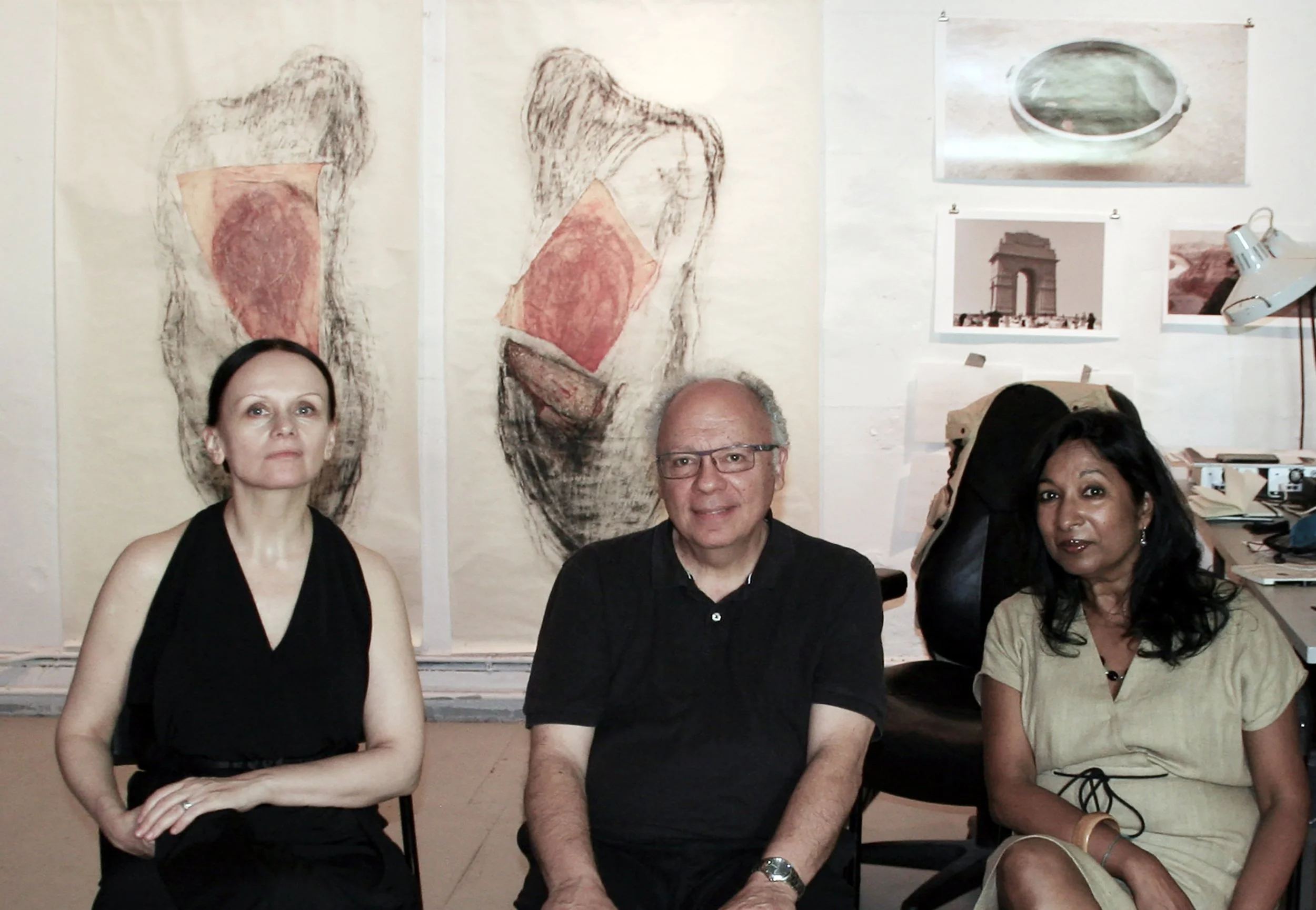
From the left: Monika Weiss, Buzz Spector and Meena Alexander, New York, 2015
Dwa Lamenty
Meena Alexander & Monika Weiss w rozmowie
Moderator Buzz Spector
2015
Tłumaczenie: Izabela Suchan
Wstęp
Canto 4 jest częścią Dwóch lamentów (19 Cantos) Moniki Weiss, serii projekcji filmowych i kompozycji dźwiękowych, które zostaną pokazane w Orońsku wiosną 2021 roku. Canto 4 zawiera wiersz Moksha, autorstwa nieżyjącej już indyjskiej poetki Meeny Alexander, zadedykowany Nirbhayi. Zgodnie z pierwotnym założeniem zapis rozmowy między Alexander i Weiss miał się ukazać w niewielkiej książce poświęconej licznym paralelom i zbieżnościom występującym w twórczości obu artystek. Wprawdzie w rozmowie przeprowadzonej w 2015 roku nie pojawił się wątek ewentualnej realizacji pomnika Nirbhaya, ani też wydania niniejszej monografii, niemniej jednak poruszone wówczas tematy, takie jak trauma, uzdrawianie, gniew niejako zapowiadały ten projekt-pomnik, który Weiss stworzyła z myślą o Orońsku i o innych miejscach na całym świecie. Specjalne podziękowania należą się historykowi Davidowi Lelyveldowi, mężowi Meeny Aleksander, który wyraził zgodę na publikację poniższych fragmentów rozmowy.
Buzz Spector
Buzz Spector: Tuż przed naszym spotkaniem obejrzałem na świeżo cztery prace Moniki z serii 19 Cantos. Ich tonacja, czy też język (langua), to zupełnie wyjątkowe połączenie smutku, gniewu i pragnienia. Może na początek powiemy kilka słów odnośnie ich powstania i ikonografii.
Monika Weiss: W październiku 2014 zostałam zaproszona przez Amita Mukhopadhyaya, kuratora z Kalkuty w Indiach realizującego projekty w przestrzeni publicznej, do stworzenia nowej pracy odnoszącej się do Delhi. Przeprowadziłam intensywny, intuicyjny research dotyczący historii tego miasta, a jednocześnie kontynuowałam pracę obejmującą relacje między lamentem i postpamięcią[1]. Skupiłam się na dwóch symbolicznych zjawiskach naznaczonych traumą: pierwsze z nich to niedawny brutalny gwałt zbiorowy dokonany na Jyoti Singh[2] (nazwanej pośmiertnie Nirbhayą[3]), do którego doszło w autobusie jadącym przez Delhi 16 grudnia 2012; drugie – pozostałość kolonializmu, czyli Brama Indii[4] wzniesiona 10 lutego 1921 z inicjatywy Komisji Grobów Wojennych Imperium Brytyjskiego[5]. Two Laments (19 Cantos)[6] to cykl złożony z 19 krótkich, eksperymentalnych projekcji filmowych poświęconych traumie w jej dwóch wymiarach: indywidualnym i społecznym. Nawiązuje on do narracji odnoszących się do wojny i przemocy seksualnej oraz ich selektywnego upamiętniania i celowego wymazywania ze świadomości społeczno-politycznej. W stenogramach z procesu gwałcicieli Jyoti Sing[7] znalazłam wypowiedź jednego z nich, który mówił, że pamięta, jak z ciała ofiary wydobywała się jakby czerwona wstęga – w dalszym postępowaniu ustalono, że były to jej wnętrzności. 19 Cantos rozpoczyna preludium, składa się na nie tekst, który napisałam podczas pobytu w Indiach – na ekranie wyświetlają się słowa pogrubioną białą czcionką na czarnym tle, w zupełnej ciszy. Podzielony na dwuwersowe części tekst ewokuje głos Nirbhayi – tak jakby powróciła do życia i została powołana na świadka. W 19 Cantos słyszymy ten tekst wielokrotnie, powtarzają go liczne kobiety mówiące w różnych językach. Zaczyna się słowami „To moja wstęga / wydobyłeś ją z mojego ciała”. Zbiorowy gwałt z 2012 roku trwał prawie dwie godziny, w tym czasie autobus nieprzerwanie jeździł po ulicach Delhi – dlatego też miałam poczucie, że całe miasto było winne tej zbrodni, i nie tylko to jedno miasto, ale wszystkie miasta świata.
Ciało Jyoti Singh zostało zmasakrowane – dosłownie wywrócone na drugą stronę – podczas potwornej, transgresyjnej kulminacji aktu przemocy, jakim jest gwałt. To zdarzenie stało się impulsem dla powstania całego projektu zatytułowanego Two Laments (19 Cantos). W 19 projekcjach filmowych widzimy młode kobiety, wolontariuszki, które wykonują powolne, powtarzające się ruchy wyrażające bezgłośny lament. Choreografowałam i filmowałam je w Nowym Delhi i w Nowym Jorku. W wielu z tych krótkich filmów pojawia się motyw czerwonej wstęgi przypominającej chustę, którą performerki trzymają w okolicach brzucha. W Canto 3[8] ta chusta-welon w poetycki sposób pokrywa rycinę przedstawiającą Stare Delhi / Old Delhi z lotu ptaka; Delhi staje się tu metamiastem, uosobieniem wszystkich miast, których historia jest naznaczona traumą. Chciałam, żeby pamięć o tym przerażającym gwałcie miała ciężar porównywalny do ciężaru monumentalnej architektury Bramy Indii, której forma nawiązuje do łuku triumfalnego. Zakładałam jednak, że moja praca nie będzie monolitem, musi być pofragmentowana, musi pulsować, nie może być linearna ze względu na swoją relację z czasem. Natomiast ciekawe i dość nieoczekiwane wydaje mi się postrzeganie tej pracy w kontekście pragnienia. Być może to pragnienie objawia się jako forma piękna – tego, które odnajduję w ziemi, w ludzkim ciele. Mapa Starego Delhi / Old Delhi pokazana w Canto 3 wywołuje poczucie niewyobrażalnej straty, jaką jest śmierć dawnych kultur i ludzi; to uczucie, które trudno opisać słowami.
Buzz Spector: Mówisz tu zarówno o tym, co zainspirowało Twoje działania, jak i o traumie, która jest katalizatorem powstającego projektu. Ta trauma jest wciąż żywa i – jak każda trauma – przeszkadza i wpływa na to, w jaki sposób się wypowiadamy.
Meena Alexander: Kiedy po raz kolejny obejrzałam Cantos Moniki, uderzyło mnie to, że ten spowolniony ruch ciała i spowolniona akcja w filmie są tak bardzo ikoniczne, w tym sensie, że jeśli chcemy stworzyć jakieś dzieło, to musimy je najpierw w imaginacyjny sposób ucieleśnić. Na przykład kiedy pracuję nad wierszem, to jest tak, jakbym zagłębiała się w emocję, która mnie wypełnia, a potem musi ze mnie wypromieniować. Żyjąc w ten sposób, trudno czasami przejść przez ulicę czy skupić się na codziennych sprawach. Pytałeś mnie wcześniej Buzz o czas, jego rolę w sztuce Moniki. Uderzyło mnie to, bo jej podejście do czasu jest mi bardzo bliskie. Istnieje medytacyjna forma wyrażania czy też ucieleśniania tego, czego żadna linia, ani żaden obraz nie są w stanie uchwycić – tego, co nienamacalne. To właśnie próbuję robić za pośrednictwem moich wierszy. Myślę, że tak naprawdę poezja jest sztuką milczenia, ponieważ słowa jedynie naprowadzają nas na trop tego, czego nie da się wypowiedzieć, można to jedynie zasugerować. Stajemy w obliczu zjawisk, których nie potrafimy nazwać. Tu, jak sądzę, ujawnia się silny związek z traumą, ponieważ trauma – podobnie jak nagły przebłysk świadomości – zmusza nas do zerwania z gramatyką codzienności.
Dwa lata zajęła mi praca nad wierszem Moksha[9], którego pomysł pojawił się, gdy jechałam pociągiem z Parmy do Modeny. Podczas postoju zobaczyłam przez okno kobietę, która wyglądała dokładnie jak moja bratowa, która zmarła kilka lat wcześniej na raka piersi. Wrażenie było niesamowite. Zaczęłam pisać wiersz, ale już po kilku linijkach go zarzuciłam. Potem w Delhi doszło do tego strasznego gwałtu. To był potworny szok, a jednocześnie coś, czego można się było spodziewać – o ile przyjmiemy, że coś spodziewanego może nas jednocześnie szokować, okazuje się, że może. Gdy miałam 23 lata mieszkałam w Delhi. Pamiętam nawet ten przystanek autobusowy w dzielnicy Munirka, ponieważ wysiadałam tam, jeżdżąc na Uniwersytet Jawaharlala Nehru[10]. W tamtych czasach nie było łatwo wsiąść do przepełnionego autobusu, byłam młoda i w tłoku nieustannie ktoś mnie poszturchiwał i podszczypywał. Delhi to stare miasto, powstawało etapami, jego kolejne warstwy nakładają się na siebie. Pod powierzchnią współczesnego Delhi kryje się kilka starożytnych miast. Gdy patrzę na Bramę Indii, wokół której skupiały się wszystkie protesty, to myślę o zniszczeniach jakich wielokrotnie doświadczyło to miasto. Po stłumieniu wielkiego powstania w 1857 roku Brytyjczycy zrównali z ziemią stare Delhi[11]. W mojej książce z 2013 roku Birthplace with Buried Stones[12] zamieściłam cykl wierszy inspirowanych poezją Mirzy Ghaliba [przyp. tłum.: poeta indyjski (1797–1869) tworzący w językach urdu i perskim], autora wyjątkowego diariusza w języku perskim zatytułowanego Dastanbuy, w którym opisał stan po zniszczeniu miasta w 1857 roku[13].
Buzz Spector: Czy w takim razie mapa, którą oglądamy w Canto 3 Moniki pochodzi z wcześniejszego okresu niż Brama Indii?
Monika Weiss: Tak, tę realistyczną rycinę przedstawiającą miasto z lotu ptaka – rodzaj mapy zatytułowanej The City of Delhi Before the Siege / Miasto Delhi przed oblężeniem, znalazłam w tygodniku „The Illustrated London News”[14], była zamieszczona na 52 stronie numeru, który ukazał się 16 stycznia 1858 roku. W Canto postać leżącej performerkizostała jakby nałożona na tę właśnie mapę.. Mamy przed oczami widok miasta w przededniu oblężenia. Performerka porusza się bardzo wolno, jest ubrana w długą, czarną suknię, która stopniowo staje się coraz bardziej ubrudzona ziemią, podłożem – tak jakby splamiło ją samo miasto. W pewnym momencie jej postać staje się dwiema kobietami, których sylwetki nakładają się na siebie i stapiają w jedno. Ostatecznie, w końcówce filmu performerka i jej sobowtór znikają, pozostawiając na powierzchni rysunkowego widoku miasta rozpostarte chusty. Poprzez odpowiedni montaż dokonałam w samym środku mapy podziału tego widoku na dwie części. Ponieważ wielkość mapy pokrywa się z rzutowanym obrazem, wydaje się, że sama projekcja również jest podzielona. Ponadto skala kobiecych ciał dostosowana została do skali miasta. Było to dla mnie bardzo ważne, ponieważ to miasto, a właściwie każde miasto, staje się w ten sposób jakby podwójnie naznaczone, uwikłane.
Meena Alexander: Myślę, że ta relacja między zgwałceniem kobiety i zgwałceniem miasta jest w Twojej pracy szczególnie ważna. W języku urdu istnieje forma lamentu nad miastem zwana marsiya[15]. To jak ukazujesz postać kobiety w Cantos jest niezwykle piękne, również ze względu na spowolniony ruch. To do mnie przemawia. Może to jest właśnie sposób, by nadać sens temu, co okrutne i absurdalne. Dobrze, że ta praca ma taki powolny rytm, zarówno jeśli chodzi o ruch, jak i muzykę, ponieważ muzyka istnieje w czasie i – w odróżnieniu od rzeźby czy literatury – nie zajmuje przestrzeni, jest niematerialna. Kiedy Twój film dobiega końca, muzyka po prostu znika, zgadza się?
Monika Weiss: Tak, znika, ponieważ przypomina akt opłakiwania, przeżywania żałoby. Ale też powraca, niczym echo. Najstarsze formy lamentu znane w starożytności polegały na imaginacyjnym dialogu między odwiedzającym a grobem zmarłego, w tym wyrażała się niemożliwość porozumienia się z kimś, kto już nie żyje[16]. W późniejszym okresie ten archaiczny lament rozwinął się i przybrał formy muzyczno-poetyckie, takie jak refren i inkantacja. Specyficzna technika montażu, za pomocą której tworzę moje projekcje filmowe i utwory dźwiękowe polega na odwracaniu obrazów i dźwięków, nakładaniu ich na siebie, po to by wykreować przestrzeń, w której czas biegnie cyklicznie (nie linearnie) – podobnie jak w przypadku inkantacji. Podoba mi się to, co powiedziałaś o poezji – że jej istota polega na wyrażeniu tego, czego nie potrafimy przedstawić. Moim zdaniem sztuka również odnosi się do tych rzeczy, których nie da się przedstawić. I ja ich w mojej sztuce nie przedstawiam. Te najtrudniejsze, bolesne tematy i traumatyczne zjawiska, fragmenty wspomnień, wydarzenia zapomniane lub wymazane z historii stają się tworzywem mojej sztuki. Jednak są to wydarzenia i zjawiska, których nie da się przedstawić, nie da się o nich „mówić”. Skutek jest taki, że moja sztuka sytuuje się w przestrzeni liminalnej, gdzieś na pograniczu: jest czymś pośrednim między przedstawianiem i nie-przedstawianiem, mówieniem i nie-mówieniem.
Meena Alexander: Myślę, że kwestią wartą namysłu jest to, jak pozycjonujesz swoje własne ciało, gdy stajesz twarzą w twarz z czymś przerażającym – zbyt przerażającym, by to ukazać. W jaki sposób się w to angażujesz, ponieważ Twoja rola wymaga niesłychanej delikatności i wyczucia, jakie jest w tym wszystkim Twoje miejsce? Nie możesz zawłaszczyć traumy, bo ona nie jest do końca Twoja. Jesteś świadkiem, ale co to właściwie znaczy? Napisałam kiedyś cały cykl wierszy zatytułowanych Letters to Gandhi[17], poświęconych wydarzeniom w stanie Gudżarat w 2002 roku, gdzie doszło do aktów przemocy skierowanych przeciwko muzułmanom[18]. Razem z przyjacielem, który zbierał zeznania naocznych świadków dla People’s Union for Democratic Rights [Ludowego Związku na rzecz Praw Demokratycznych] odwiedzaliśmy obozy pomocy humanitarnej[19]. Wysłałam potem te wiersze przyjacielowi z Delhi, on z kolei przekazał je komuś pracującemu w dzienniku „The Hindu”. W gazecie zamieszczono cały ten cykl, co było zupełnie wyjątkowe. Nie zapomnę, jak redaktor, pisząc do mnie, zwracał uwagę na niezwykłe piękno tych wierszy, ale też na to, że muszę pamiętać, iż ludzie bywają nieufni w stosunku do sztuki, myślą: jak to możliwe, że takie straszne rzeczy mogą przyczynić się do powstania czegoś tak pięknego. Odpisałam mu wtedy, że według mnie rola piękna polega na tym, by – poprzez czułość i empatię – kierować nas ku ziemi i życiu, od których zostaliśmy niejako odcięci przez ekstremalną przemoc. Tę naszą wymianę zdań zamieściłam potem w eseju zatytułowanym Fragile Places poświęconym tworzeniu sztuki w czasach przemocy. Znajduje się on w książce – zbiorze esejów Poetics of Dislocation[20]. Sztuka naprawdę może wiele zdziałać: zwłaszcza jeśli jej tworzywem uczynimy piękno.
Monika Weiss: Miasto rozumiane jako przestrzeń publiczna chroni swoją pamięć publiczną, toteż nie chce być „zanieczyszczane” śladami po zbrodniach dokonywanych na kobietach. Gwałt na kobiecie jest kulturowo związany z faktem, że jest ona „ofiarą” i jako taki skrzętnie wymazywany z pamięci kulturowej. Ciało kobiety w sferze publicznej jest ciałem flâneuse. W Canto 3 Nirbhaya przesłania swoim ciałem całą powierzchnię miasta. Celowo dostosowałam skalę jej ciała do skali mapy-miasta – żeby podkreślić ten aspekt.
Meena Alexander: O to właśnie chodzi. Trzeba dostosować skalę, żeby to, co robimy miało sens, było zrozumiałe. Moja praca nad wierszem wiązała się z doświadczeniem czasu; to był problem, który musiałam rozwiązać. Zaczęłam pisać w Parmie, ale skończyłam dopiero dwa lata później w Shimla, ponieważ czułam, że muszę go skończyć właśnie w Indiach. Potrzebowałam czasu, żeby się zdystansować, poza tym chodziło też o pewną muzyczność tego wiersza. Punktem zwrotnym utworu jest moment, kiedy widzę dwie kobiety i słyszę ich śpiew.
Monika Weiss: Ten fragment wiersza, w którym zdajesz sobie sprawę, że widzisz i słyszysz dwie kobiety jest bardzo ważny. To ze względu na ten moment w wierszu włączyłam Mokshę do Canto 4. Mój film – projekcja odbywa się bez dźwięku. Widzimy zbliżenie twarzy kobiety stojącej na tle pustej ściany; jest zwrócona w naszą stronę i ma zamknięte oczy. Powoli unosi głowę i przechyla ją w tył, aż do oporu po czym opuszcza z powrotem, powtarza ten gest do momentu, gdy jej postać znika z ekranu. W Canto 4 ruch ten powtarza się kilkakrotnie. W przeciągu czterech minut – tyle trwa projekcja – bohaterka dwukrotnie otwiera oczy i patrzy prosto na nas. Chodziło mi o stworzenie specyficznego kontrapunktu między każdymi dwoma wersami wiersza Meeny – wyświetlają się one na dole obrazu podobnie jak napisy w filmie – i stopniowym ruchem kobiecej głowy. W pewnym momencie pojawia się pojedynczy wers, również zaczerpnięty z wiersza: „zanim powstały wszystkie języki”. Po tych słowach w filmie następuje dłuższa przerwa. Wczoraj, gdy czytałaś Mokshę na spotkaniu w The New York Public Library, to było wspaniałe przeżycie, z tym, że tempo wiersza było o wiele szybsze niż je sobie zawsze wyobrażałam. Fraza ,,zanim powstały wszystkie języki” może być równie dobrze początkiem, jak i końcem zdania. Dla mnie ta fraza oznacza, że znajdujemy się w miejscu liminalnym, w którym doszło do gwałtu. Delhi to szczególne miasto, podobnie jak szczególne jest ciało Nirbhayi – oba ucieleśniają wszystkie gwałty i wszystkie miasta świata. W Two Laments miejsce traumy, jakim jest ciało Nirbhayi zostaje niejako „zrekonstruowane” i „zamieszkane” przez wiele różnych kobiet – zabieg ten w symboliczny sposób przekierowuje nasze dotychczasowe spojrzenie. W Canto 4, za pośrednictwem jej ciała przenosimy się w przestrzeń bez słów – w przestrzeń, która istniała ,,zanim powstały wszystkie języki”. Przebywamy w przestrzeni lamentu, ponieważ ogrom grozy nie da się wypowiedzieć słowami.
Meena Alexander: Te dwa wersy pojawiają się w moim notatniku na osobnej stronie, ponieważ były dla mnie wyjątkowo ważne. Przywołują emocje, jakie odczuwałam, gdy miałam dwadzieścia lat i mieszkałam w Delhi, mieliśmy tam piękny różany ogród. Całe miasto pełne jest wspaniałych, niezwykłych kwiatów. Myślę, że istnieje jakiś sposób, by tę ekstremalną przemoc, łącznie z gwałtem, którego ofiarą padła Jyoti Singh, wyrazić i zneutralizować w działaniu będącym rodzajem szyfru. Być może odnosi się to również do Twojej praktyki artystycznej. Wydaje mi się, że to jest właśnie zadanie dla sztuki, ponieważ jest to sfera wymagająca wielkiej delikatności, ale także intensywnych emocji. Jesteś w tej materii negocjatorką – oscylujesz między brutalną niesprawiedliwością, horrorem przemocy i etycznością piękna. Dlatego tak bardzo podoba mi się ten Twój pomysł ze spowolnionymi gestami i powolną kompozycją. Pod koniec Canto 4 kobieta patrzy prosto na nas. Ona czegoś wypatruje, chce zobaczyć coś jeszcze, być może czegoś pragnie – może czegoś od nas oczekuje?
Uważa się powszechnie, że musi minąć pięćdziesiąt lat – to jest cała generacja, a może i więcej – zanim społeczeństwa dojrzeją do tego, by zmierzyć się z pamięcią o masowej przemocy, której w swojej historii doświadczyły. Tak było z krwawymi zamieszkami, do jakich doszło podczas podziału Indii[21]. Czasami takie wydarzenia sprawiają, że czujemy się zobligowani do stworzenia jakiegoś dzieła. Na przykład ja nigdy nie mieszkałam w Niemczech. Spędziłam tylko ponad miesiąc w Palestynie. Z kolei Ty nigdy wcześniej nie byłaś w Indiach. Ale w naszej pracy nie o to chodzi. Po prostu wydaje mi się, że każdy artysta ma swoje własne DNA i własne odciski palców – to one nadają jego twórczości ów specyficzny charakter. To sprawia, że dzieła sztuki są wyjątkowe. To dzięki temu Ty i ja możemy reagować wzajemnie na nasze prace w osobisty, indywidualny sposób. W 2005 napisałam wiersz Aletheia[22] inspirowany Twoją rzeźbą i performancem Lethe Room. Tym co fascynuje mnie w Twojej pracy jest podejście do ciała, sposób, w jaki je wykorzystujesz – podziwiam to i uważam, że jest niesamowicie poruszające. To jak wykorzystujesz ciało pozwala Ci dotknąć miejsca, które istnieje poza tym, co sobie uświadamiamy. Chyba do tego zmierzam również w moich wierszach.
Buzz Spector: Właśnie to mnie interesuje. Dzieląc Twój wiersz na dwa wersy, Monika nadała mu specyficzne tempo. Każdy fragment jest widoczny na ekranie przez dłuższą chwilę. Chodzi o różnicę między prędkością ruchów sfilmowanych w pracy Moniki i faktyczną prędkością, z jaką podobne gesty wykonuje się w realnej przestrzeni, w czasie rzeczywistym. Meeno, podejrzewam, że Ty przeczytałabyś swój wiersz w innym tempie, wymawiając słowa bardziej ostro, twardo. Raczej nie przeciągałabyś każdego słowa, to nie trwałoby tyle, ile trwa w Canto 4 Moniki?
Meena Alexander: Zgadzam się, wydaje mi się, że Monika nadała tym wersom walor muzyczny.
Buzz Spector: Słowa nie są wypowiadane na głos. Musimy je przeczytać. Nie są to jedynie puste znaki towarzyszące scenie, której akcja zredukowana została do ruchów kobiety. Czytamy więc kolejne wersy. Treść każdego dwuwiersza odnosimy do widocznej na ekranie twarzy. Co ciekawe, każda kolejna zwrotka wiersza jest jak ożywczy impuls: rodzi pytanie, które zadajemy sobie od nowa: „czy to ta sama kobieta?” A ona jest najpierw Twoją bratową, potem przeistacza się w Nirbhayę, w końcu staje się nimi obiema.
Meena Alexander: Moniko, podczas naszego ostatniego spotkania w Maribelle zadałaś mi pytanie. Rozmawiałyśmy o podwójności – o tym, czym ona jest w naszej sztuce. Wydaje mi się, że w Twojej pracy jest ona bardzo ważna. Później, po naszym spotkaniu, zastanawiałam się nad tym, jadąc metrem. Przyszły mi do głowy dwie rzeczy. Pierwsza: mędrzec i poeta Walmiki, przystanął kiedyś na brzegu rzeki i obserwował dwa godujące ptaki. W pewnym momencie samiec został śmiertelnie trafiony strzałą. Osierocony ptak, który pozostał przy życiu wydawał tak żałosne dźwięki, że duszę poety wypełniło głębokie wzruszenie, przeżycie to miało go skłonić do napisania eposu Ramayana[23]. Druga rzecz, o której myślałam w pędzącym metrze również miała związek z ptakami. Chodzi o pojęcie sakshi[24] pojawiające się w Upaniszadach[25]. Na drzewie siedzą dwa ptaki; jeden ze smakiem zjada dojrzały owoc, drugi obserwuje go w milczeniu. Ten drugi jest niejako świadkiem świadomości. My potrzebujemy obu tych bytów, obu ptaków, tak w życiu jak i w sztuce. Wróćmy do Walmikiego, do tego, co poeta pisze o ptakach. Mamy dwa ptaki, jeden ginie, potem na bazie emocji i żalu wywołanego tym faktem rodzi się poezja. Zawsze są jakby dwa byty, jest podwójność, przynajmniej w niektórych nurtach, nurcie starożytnej, klasycznej estetyki sanskrytu. Nie jeden, ale dwa.
Buzz Spector: To bardzo ważne, że ta jedna kobieta staje się dwiema czy też, że widzimy dwa razy tę samą kobietę. Nie jest przez cały czas „pojedyncza”. Wykreowanie w naszej wyobraźni dwóch wizerunków jednej osoby – chociażby przez to, że pokażemy ją dwa razy wcale nie jest łatwe, tu potrzeba specyficznych środków, trzeba wyczarować coś w rodzaju halucynacji, która pozwoli ukazać tę dwoistość – to niemożliwe rozdzielenie. Nikt z nas nie jest „pojedynczy”. Sfilmowany wizerunek jest wizerunkiem raz jednej, raz drugiej osoby; ukazuje tę jedną razem z tą drugą, a także tę jedną jako tę drugą. Tego wszystkiego doświadczamy dzięki Twojej pracy, której elementy również są podwojone. W Canto 3 mamy kartę (mapę) złożoną z dwóch części, na dole każdej z nich powtarza się ten sam napis, co wygląda osobliwie, ponieważ panorama miasta na obu stronach stanowi nieprzerwaną całość. Mapa – podobnie jak karta z książki – ma charakterystyczną cechę: pionowy ślad złożenia, ów szew spajający obie części w jedno. Dwie strony łączą się w jedną całość w książce, jedno ciało staje się dwoma, do tego dochodzi powolny ruch odpowiadający powolnemu przewracaniu strony. Dodałaś nawet dwie chusty: czerwoną i czarną – niczym kolejne strony.
Meena Alexander: Dlatego w Canto 4 każda strofa jest jak strona, która się przed nami otwiera. Dwuwiersz wypełnia całą przestrzeń. Obie mamy elegijną wyobraźnię. Jak to kiedyś napisałam: „Mamy poezję, więc nie umrzemy z powodu historii”[26].
Tobie i mnie towarzyszy muza lamentu. Są artyści i poeci, którzy różnią się od nas, ich stosunek do teraźniejszości jest całkiem inny. Dla mnie i dla Ciebie najważniejsza jest pamięć, to ona stoi na pierwszym miejscu. Może stąd właśnie bierze się ta podwójność – wyraz naszego mnemonicznego podejścia do rzeczy.
Fragmenty niepublikowanej rozmowy Moniki Weiss i nieżyjącej już poetki Meeny Alexander, nagranie powstało latem w 2015, moderatorem rozmowy był Buzz Spector. Rozmowy artystek nagrywane były podczas spotkań odbywających się w latach 2015–2018, przerwała je przedwczesna śmierć Meeny Alexander jesienią 2018.
[1] Pojęcie „postpamięci” zaproponowane przez Marianne Hirsch opisuje „stosunek przedstawicieli drugiego pokolenia do bolesnych, często traumatycznych doświadczeń, które wprawdzie wydarzyły się przed ich narodzinami, ale zostały przez nich niejako odziedziczone i zapisane w pamięci jako własne”. Zob. The Generation of Postmemory, „Poetics Today” 29.01.2008, s. 103.
[2] Dwudziestotrzyletnia Jyoti Singh i jej przyjaciel Awindra Pratap Pandey zostali napadnięci w autobusie kursującym po Delhi, do zdarzenia doszło wieczorem 16 grudnia 2012 w jednej z dzielnic Delhi – Munirka. Sześciu mężczyzn pobiło do nieprzytomności przyjaciela Jyoti Singh, a ją brutalnie zgwałciło, wskutek odniesionych obrażeń młoda kobieta po kilku dniach zmarła. Zob. Delhi gang-rape victim dies in hospital in Singapore, BBC News, 29 grudnia 2012, https://www.bbc.com/news/world-asia-india-20860569.
[3] Nirbhaya w języku hindi znaczy „Nieustraszona”.
[4] Brama Indii powstała w celu upamiętnienia 82 000 indyjskich żołnierzy, którzy zginęli w czasie I wojny światowej. Kamień węgielny pod budowę położono w 1917, cały pomnik ukończono w 1931.
[5] Komisja Grobów Wojennych Imperium Brytyjskiego (od 1960 jej nazwa brzmi: Komisja Grobów Wojennych Wspólnoty Narodów) została powołana na mocy Karty Królewskiej (Royal Charter) w 1917 w celu „upamiętnienia poległych na wojnach żołnierzy, ich liczbę po zakończeniu II wojny światowej szacuje się na 1,7 miliona, cmentarze żołnierzy i poświęcone im miejsca pamięci znajdują się w 150 krajach. Komisja kieruje się zasadą, że „każdy zmarły zasługuje na indywidualne upamiętnienie, jeśli jest to pomnik zbiorowy, to na płycie grobowej lub tablicy powinno znaleźć się imię i nazwisko żołnierza, nagrobki i pomniki mają mieć charakter trwały, ich wygląd ma być jednolity, bez zróżnicowania ze względu na stopień wojskowy lub służbowy, rasę i wyznanie”. Peter J Francis, Commonwealth War Graves Commission, w: The Oxford Companion to Military History, red. Richard Holmes, Charles Singleton i Spencer Jones, Oxford 2001, Oxford University Press.
[6] Monika Weiss Two Laments (19 Cantos): film, dźwięk, rysunki i tekst powstały w ramach rezydencji artystycznej w Fundacji Sanskriti w Nowym Delhi, 2015. Inspiracją dla pracy Two Laments był złożony z 19 pieśni cykl trenów Jana Kochanowskiego poświęcony pamięci zmarłej córki. Projekt Two Laments dedykowany jest Jyoti Singh.
[7] W stenogramach z procesu natknęłam się na zeznanie jednego ze sprawców gwałtu, który zapamiętał, że z ciała Jyoti Singh wydobywała się czerwona wstęga.
[8] W Canto 3 z cyklu Two Laments (19 Cantos) oglądamy kobietę odtwarzającą gesty lamentu, jej ciało niejako przenika się z tłem, jakim jest mapa Starego Delhi (Old Delhi). Z ciała kobiety wydobywa się czerwona wstęga-chusta poetycko spowijająca Delhi, które staje się metamiastem, uosobieniem wszystkich miast naznaczonych śladem traumy.
[9] Meena Alexander, Moksha, „The Hindu” (7 grudnia 2014). Więcej na stronie dziennika „The Hindu”: https://www.thehindu.com.
[10] Uniwersytet im. Jawaharlala Nehru (założony w 1969) jest publiczną placówką mieszczącą się na terenie Nowego Delhi. Więcej informacji na temat założenia uniwersytetu i jego profilu na stronie: www.jnu.ac.in.
[11] 10 maja 1857 „trzystu zbuntowanych sipajów [żołnierze indyjskiej piechoty w armii brytyjskiej] i kawalerzystów z Miratu [Meerut] wtargnęło do Delhi i zajęło miasto, wymordowano wszystkich znajdujących się tam chrześcijan: mężczyzn, kobiety i dzieci, przywódcą powstania obwołano Zafara [ostatniego cesarza z dynastii Mogołów]”. Brytyjczycy oblegali Delhi przez długi czas i ostatecznie zdobyli je głodem, 14 września wkroczyli do miasta „plądrując co się dało i masakrując rzesze ludności. W jednym tylko kwartale [muhalla, neighborhood] zwanym Kucha Chelan wycięto prawie 1400 mieszkańców. Był rozkaz, żeby strzelać do każdej żywej duszy – wspomina Edward Vibart, dziewiętnastoletni oficer armii brytyjskiej”. William Dalrymple, The Last Mughal: The Fall of a Dynasty, Delhi, 1857, New York 2007, Alfred A. Knopf, s. 3–4.
[12] Meena Alexander, Birthplace with Buried Stones, Evanstone 2013, Northwestern University Press.
[13] „Pozbawione prawowitych władców miasto Delhi zaludniło się stworzeniami Pana, które nie uznawały żadnego pana – stało się jak ogród bez ogrodnika, pełen drzew niewydających owoców”, Mirza Asadullah Khan Ghalib, Dastanbuy: A Diary of the Indian Revolt of 1857, przekład na ang. Khwaja Ahmad Faruqi, New York 1970, Asia Publishing House, s. 33.
[14] The City of Delhi Before the Siege, „The Illustrated London News” 16 stycznia 1858, s. 52. „The Illustrated London News” był tygodnikiem ilustrowanym poświęconym wydarzeniom międzynarodowym. Opublikowana zaledwie cztery miesiące po zakończeniu oblężenia Delhi ilustracja przedstawia malowniczy widok miasta, które właśnie zostało zniszczone.
[15] „Termin marsiya (elegia) pochodzi od arabskiego słowa risa, oznaczało ono pochwałę (zmarłego) wygłaszaną podczas pogrzebu, obejmującą płacz i zawodzenie nad jego ciałem. Marsiya to rodzaj utworu poetyckiego opiewającego zalety osoby zmarłej, recytowano go by wyrazić smutek z powodu śmierci; upamiętniał bolesne i przygnębiające wydarzenie”. Marsiya rozwinęła się na terenie dekańskich stanów Indii jako lokalna – perska forma poetycka i przeżywała swój rozkwit w XVI i XVII wieku. Forma ta rozpowszechniła się również w Indiach Północnych, gdzie utwory typu marsiya powstawały nie tylko w języku perskim, lecz także w urdu. Marsiya to rytuał żałobny, elegijna forma muzyczna oraz gatunek literacki. Madhu Trivedi, Invoking Sorrow: Marsiya in North India, w: Traditions in Motion: Religion and Society in History, red. Satish Saberwal, Supriya Varma, Oxford 2005, Oxford University Press, s. 127–131.
[16] Więcej na temat lamentu w: Lament: Studies in the Ancient Mediterranean and Beyond, red. Ann Suter, Oxford 2008, Oxford University Press, oraz Margaret Alexiou, The Ritual Lament in Greek Tradition, Lanham 2002, Rowman & Littlefield Publishers, Inc.
[17] Meena Alexander, Letters to Gandhi, „The Hindu” (6 lipca 2003).
[18] 28 lutego 2002 w jednym z indyjskich stanów – Gudżaracie rozpoczął się antymuzułmański pogrom, który trwał przez trzy dni. Niszczono domy i miejsca kultu muzułmanów, bojkotowano ich sklepy i przedsiębiorstwa, zabijano wyznawców islamu. W przeciągu trzech dni wypędzono z domów 150 000 ludzi, zabito ponad 1000 osób, w większości muzułmanów. W kolejnych miesiącach dochodziło do aktów przemocy i masowych zabójstw. Z przekazów medialnych wynikało, że w ten oto brutalny sposób realizuje się rzekomo scenariusz ,,hinduskiego przebudzenia”. Antropolog Ghassem-Fachandi twierdzi, że: „energetyczne doświadczenie »hinduskiego przebudzenia« zdewaluowało się i spaja obecnie społeczną wspólnotę opartą na negatywnych emocjach i postawach. Hasło budzi też destrukcyjne impulsy, daje nihilistyczną w istocie gwarancję spójności grupy umożliwiającą odreagowanie w pewnych określonych okolicznościach – można określić je mianem zamieszek, które niosąc wiele potencjalnych zagrożeń, wydają się jednak poddane mikrozarządzaniu i kontroli”. Cyt. z Pogrom in Gujarat: Hindu Nationalism and Anti-Muslim Violence in India, Princeton / Oxford 2012, Princeton University Press, s. 259–260.
[19] The People’s Union for Democratic Rights jest ,,organizacją działającą na rzecz demokracji oraz praw i swobód obywatelskich, jej siedziba znajduje się w Delhi, w Indiach”. Więcej informacji na stronie: https://www.pudr.org.
[20] Meena Alexander, Poetics of Dislocation, Ann Arbor 2009, University of Michigan Press.
[21] „16 sierpnia 1946 w Dniu Akcji Bezpośredniej [gdy Liga Muzułmańska wycofała się z negocjacji z Kongresem] w Kalkucie wybuchły zamieszki między hinduistami i muzułmanami. Fala przemocy rozlała się szeroko we wszystkich kierunkach, ogarniając do marca 1947 również północne stany Indii. … Jeden z brytyjskich generałów opisywał, że ataki były niezwykle zaciekłe i błyskawicznie przenosiły się z miast na tereny wiejskie. W miastach Rawalpindi i Multan »ataki nigdy wcześniej nie wybuchały tak niespodziewanie, nie były aż tak brutalne i dzikie. Na obszarach wiejskich organizowali je muzułmańscy chłopi, którzy skrzykiwali się z kilku wiosek i przysiółków, by wspólnie rabować okoliczne sklepy i domy należące do Sikhów i Hindusów. W niektórych miejscach zdziczenie doszło do tego stopnia, że mężczyzn, kobiety i dzieci masakrowano, bito na śmierć, a nawet palono w ich własnych domach«. …Wiele osób wolało odebrać życie sobie i członkom rodziny niż poddać się i żyć w hańbie. Najbardziej znanym przykładem takiej postawy jest zbiorowe samobójstwo ponad 90 kobiet i dzieci z wioski Thoa Khalsa”. Gyanendra Pandey, Remembering Partition: Violence, Nationalism and History in India, Cambridge 2001, Cambridge University Press, s. 23–24.
[22] Meena Alexander, Aletheia, w: Quickly Changing River: Poems, Evanston 2008, Northwestern University Press, s. 28.
[23] „Ramayana Walmikiego to epos sanskrycki złożony z 50 000 wersów opowiadający o życiu Ramy, legendarnego księcia starożytnego królestwa Kosala położonego we wschodniej części północno-środkowych Indii”. Nie ma zgodności co do daty powstania tego dzieła, kształtowało się prawdopodobnie od VI w. p.n.e. od IV w. n.e. Zob. Robert P. Goldman, wprowadzenie do The Rāmāyaṇa of Vālmīki, Princeton 1984, Princeton University Press, s. 4–5, 14.
[24] Sakshi w języku hindi znaczy ,,świadek”.
[25] Upaniszady „to natchnione nauki wygłaszane przez mężczyzn i kobiety, dla których transcendentna rzeczywistość / realność zwana Bogiem jest bardziej rzeczywista niż świat odbierany zmysłami. Celem nauk nie jest instruowanie czy też inspirowanie czytelnika: są pomyślane jako nauki oświeconego nauczyciela udzielane na podstawie osobistych doświadczeń”. Autorstwo i data powstania tych tekstów nie są ustalone, zamieszczone zostały w Wedach [przyp. tłum.: świętych księgach hinduizmu] wywodzących się ze starożytnych hymnów sanskryckich, z których najstarsze datuje się na 1500 p.n.e. Zob. Easwaran Eknath i Michael N. Nagler, The Upanishads, Tomales 2007, Nilgiri Press, s. 17–20.
[26] Meena Alexander, “Question Time” Birthplace with Buried Stones, Evanstone 2013, Northwestern University Press.
Two Laments (19 Cantos) - Canto 4, 2015 by Monika Weiss was directed, choreographed, filmed and edited by the artist. Movement performer: Vinita Dasgupta. Moksha by Meena Alexander was later published in her book of poetry Atmospheric Embroidery. Copyright © 2018 by Meena Alexander, Northwestern University Press. All rights reserved.
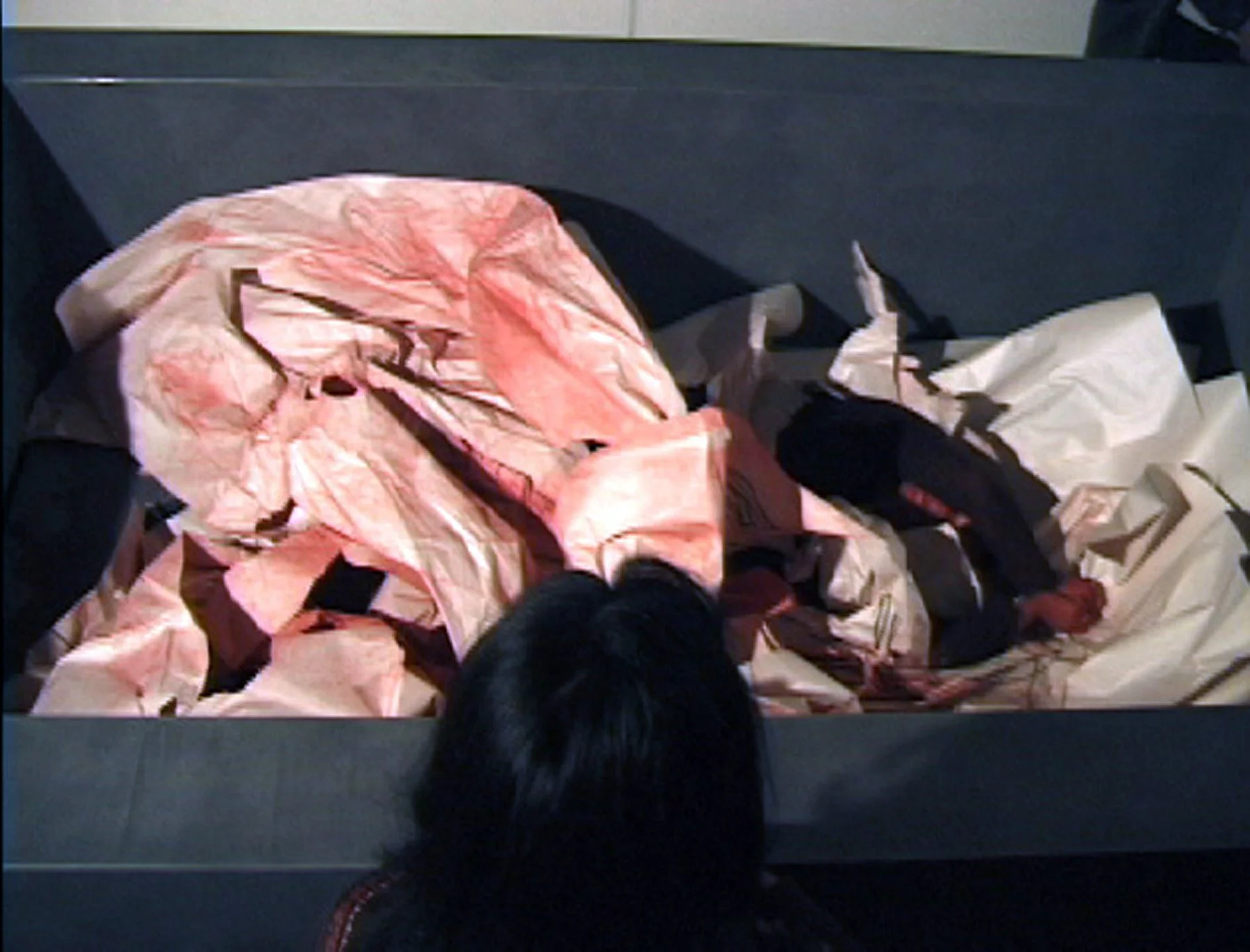
Meena Alexander observing Monika Weiss’ performance in 2005 Lehman College Art Gallery, Bronx, New York. The artist is lying inside her sculpture, Lethe Room, 2004-2005 and drawing around her body with chunks of charcoal and dry pigment, as part of the survey exhibition Monika Weiss: Five Rivers, 2005-2006.