Monika Weiss - Anamnesis, 2006
Monika Weiss
Anamnesis - światlo dnia
I walk up narrow stairs leading to a door, which opens to a large oval terrain covered by untrimmed grass, with occasionally visible tops of colossal stones that must have been here for thousands of years. The ground is covered by man-made cavities surrounded by blue and red thread lines, demarcating an ongoing archeological research. The meadow is surrounded by a thick wall, made from single stones, the way it was usually build in medieval centuries, with the last layer interrupted by regular intervals of the openings for the soldiers and their arches ready to shoot at the approaching enemy. The place is elevated enough to see well the surrounding towns and forests. The smell and the shimmering of the grass and the trees gradually enter my senses. They are trembling in the wind, whispering quietly, generations hidden underneath my feet.
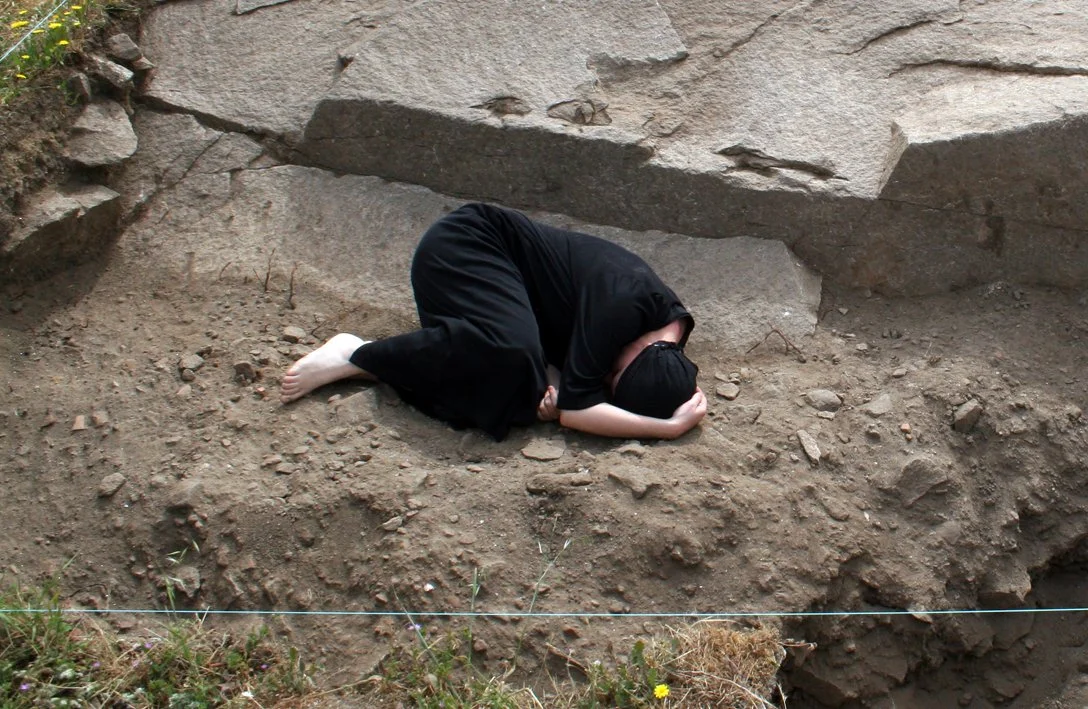
I bend towards one of the archeological cavities. Inside are layers of earth, exposed, collapsing. The following day I speak with an archeologist and achieve a permission to lie inside the cavity. The roughness of the small stones gently hurts my skin through the layer of clothing. “But if the earth is only the dispersion of body, can we cross the distance and conquer the absence?”[i] I document placing my body inside those temporary vessels, my homage to Ana[ii], leaving invisible imprints, marks, each like a sensitive interval that brings back the presence. I search for states of regression from image and coded sign to states of pre-sign, moments of inscription, the emergence of the signifier from gesture or from act of making the mark. “I secure the exchange, transmit what emerges from it, let it slip, deliver the lines and phrases, strip them naked, give them a new measure of freedom, lay the trace bare again, shutter it, strengthen it, destroy it, efface it, effuse its reminders, charge the traces with the intensities coming from myself and from the other, from outside and from within, and I listen carefully.[iii]
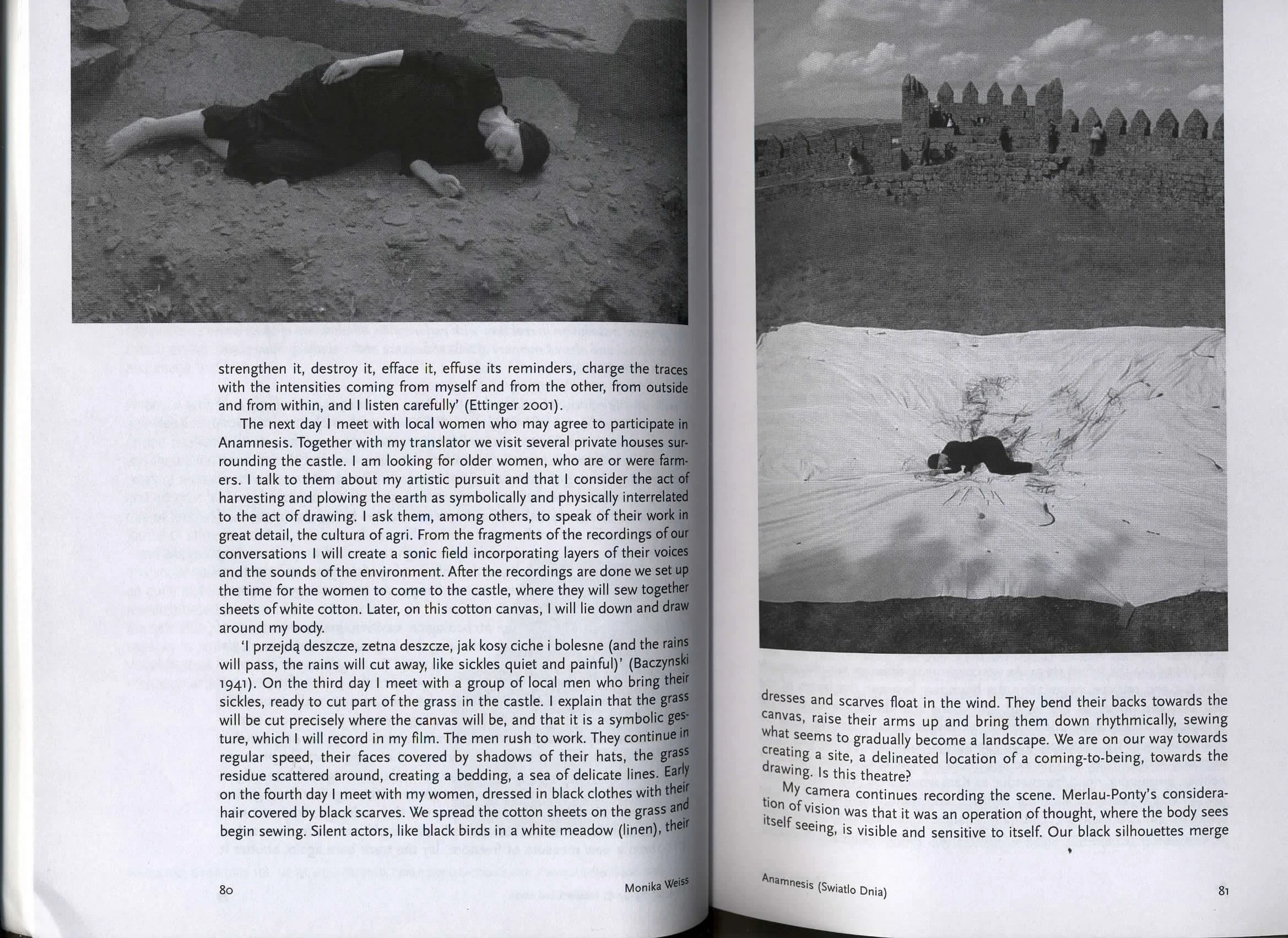
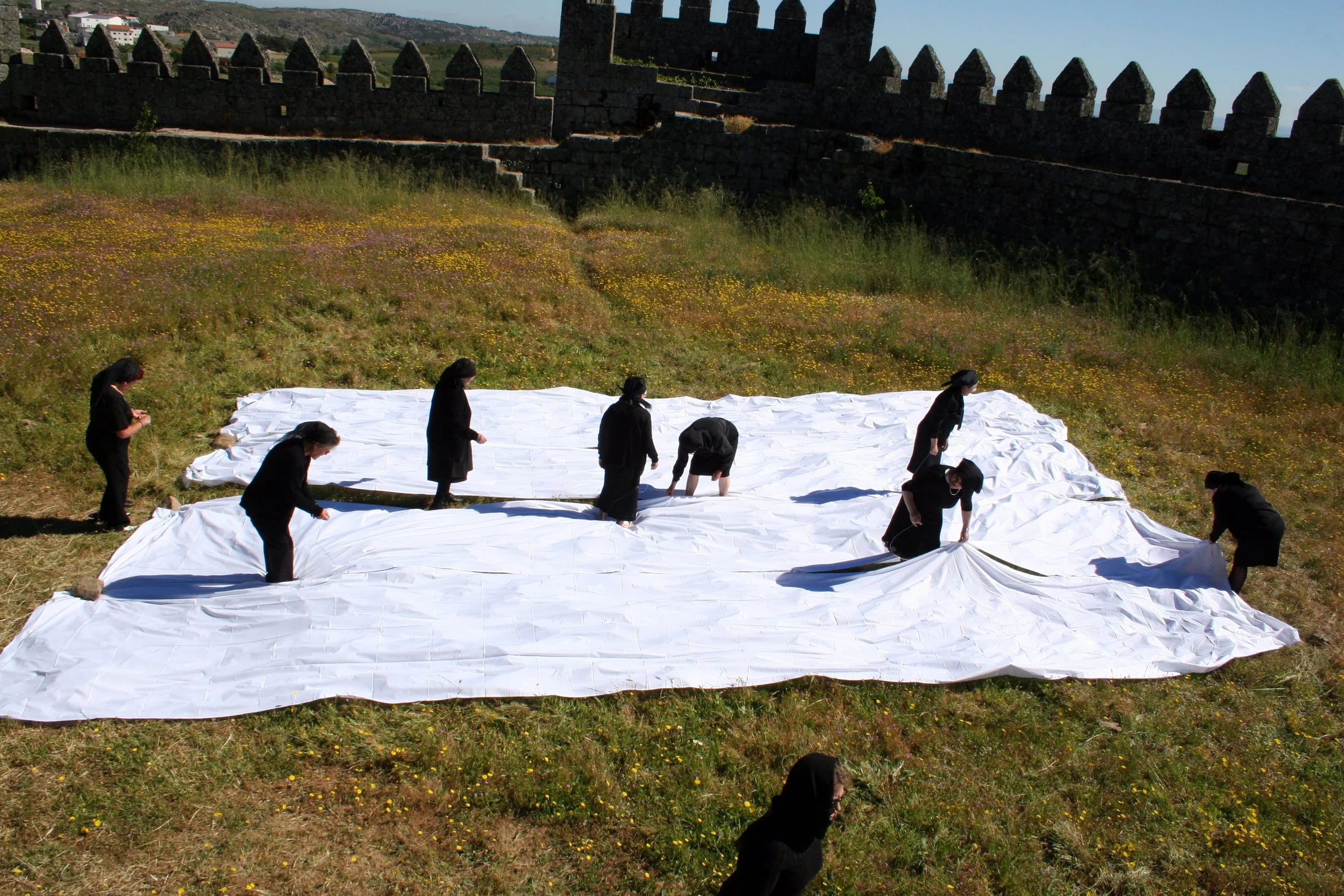
The next day I meet with local women who may agree to participate in Anamnesis. Together with my translator we visit several private houses surrounding the castle. I am looking for older women, who are or were farmers. I talk to them about my artistic pursuit and that I consider the act of harvesting and plowing the earth as symbolically and physically interrelated to the act of drawing. I ask them, among others, to speak of their work in great detail, the cultura of agri . From the fragments of the recordings of our conversations I will create a sonic field incorporating layers of their voices and the sounds of the environment. After the recordings are done we set up the time for the women to come to the castle, where they will sew together sheets of white cotton. Later, on this cotton canvas, I will lie down and draw around my body.
“I przejdą deszcze, zetna deszcze, jak kosy ciche i bolesne (and the rains will pass, the rains will cut away, like sickles quiet and painful)” [iv] On the third day I meet with a group of local men who bring their sickles, ready to cut part of the grass in the castle. I explain that the grass will be cut precisely where the canvas will be, and that it is a symbolic gesture, which I will record in my film. The men rush to work. They continue in regular speed, their faces covered by shadows of their hats, the grass residue scattered around, creating a bedding, a sea of delicate lines. Early on the fourth day I meet with my women, dressed in black clothes with their hair covered by black scarves. We spread the cotton sheets on the grass and begin sewing. Silent actors, like black birds in a white meadow (limen), their dresses and scarves float in the wind. They bend their backs towards the canvas, they raise their arms up and bring them down rhythmically, sewing what seems to gradually become a landscape. We are on our way towards creating a site, a delineated location of a coming-to-being, towards the drawing. Is this theatre?
My camera continues recording the scene. Merlau-Ponty’s consideration of vision was that it was an operation of thought, where the body sees itself seeing, is visible and sensitive to itself. Our black silhouettes merge with the landscape, we see each other, sensitive to each other, visible to each other. What does theatre become with the end of the metaphysical basis for the distinction between truth and illusion? According to Nietzsche the modernity is about the collapse into one of this duality. The pre-modern “theatre of the world” opposes the mutability of illusion with the truth of redemption. It depends on the idea of two worlds: the world of appearances and the real world behind or elsewhere. Staging implies self-consciousness, a potentially infinite regress; the subject as spectator of its own representations. Where is the seen and where is the seeing subject?
“The gesture is the exhibition of a mediality; it is the process of making a means visible as such. It allows the emergence of the being-in-the-medium of human beings and thus it opens the ethical dimension for them (...) the gesture is communication of communicability. It has precisely nothing to say because what it shows is the being-in-language of human being as pure mediality. However, because being-in-language is not something that could be said in sentences, the gesture is essentially always a gesture of not being able to figure something out in language.”[v]
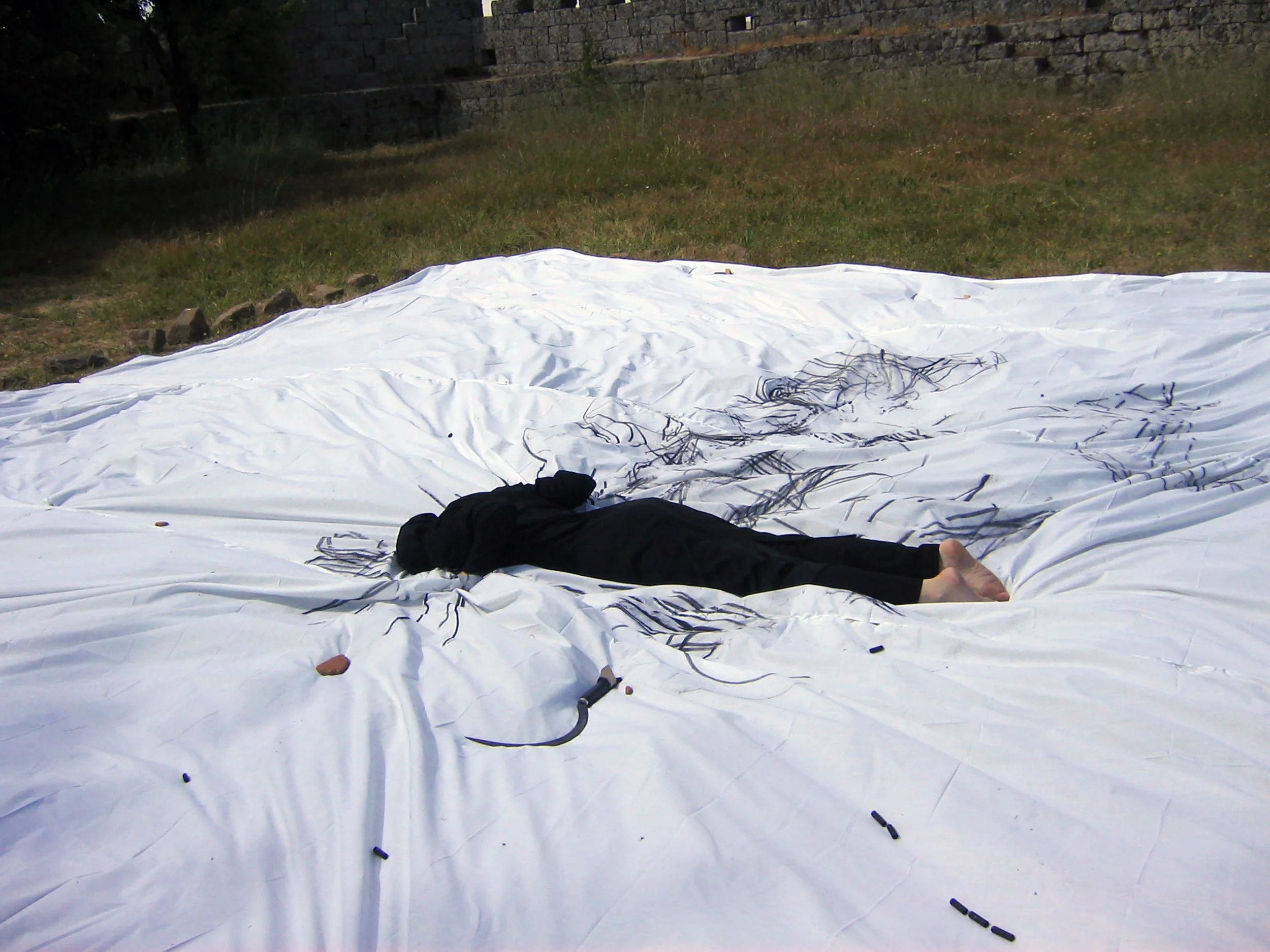
On the morning of the following day I lie on the canvas alone, awaiting the sun to appear in full. The camera registers changes in swiatlo dnia (“ the light of the day”), intensified by strong winds. Later that day the door is open for the public. One by one people are let inside the castle. They are asked to remain silent. Once inside they approach towards the portion of the ground covered by white canvas. My eyes are closed. With graphite and charcoal in both of my hands I continue to draw around my body. Marks are dispersed, irregular, hard to execute and impossible to control, left on the fabric covering the soft, thick bedding of grass. Is there ever a moment before, when the mark is unrepeatable, and if so, can we ever have access to it? The status of the mark as not yet sign, not yet writing, not yet language. Drawing because of its status as becoming (blot becoming mark, mark becoming line, line becoming contour, contour becoming image, image becoming sign ... the direction of this movement being always reversible) offers a continuum of sense, from one sense to the other, yet it seems impossible to observe, or to capture, the precise moment, or experience, of that transition from pre-sign, differentiate, but not yet diacritically caught in an opposition, to signification, image, and meaning.
Attendees remain silent. Some decide to join me inside the canvas. They lie down and take the drawing tools in their hands, their bodies stretched or curled up, alongside scattered sickles. Gesture is linked to the inscriptive act and has its origins in a desire to mark. It possibly arises from a time when original sensory centers were connected together on the surface of body in the infant stage. As we continue to draw we are simultaneously casting out and retrieving, negotiating the boundary between the layers of the self and the layers of the world, the many membranes and skins of estrangement and separation, which, as mystics would believe, may be abandoned and transgressed, if only temporarily. Silence (milczenie) is an imposed and a shared experience. My decision to withdraw from speech is neither “unmundig” nor “ubermundig” as Kant would wish. My “speech” consists of acts of presence, minimal, rhythmic and sonic. The imposed silence interests me primarily in culturally charged circumstances and sites, such as gallery/museum spaces, conferences, public venues. The site is addressed by silence as a place for (not of) transformation and passage (Battaille’s sacred place), where through states of heightened alertness and consciousness, in stillness and muteness, the porous boundary between here and non-here may be acknowledged.
Through the immediacy, the proximity that, more than any other medium, it appears to offer, drawing becomes an event, or as Levinas would say the dramatic event of “being immersed in being”. But it is an event that is also a thing, in its materiality, the event of its happening is laid and preserved in charcoal and graphite. The drawing’s relation to language lies not in language as a goal, but in exposing its mediality, which is the condition of language. We seem to conceive the language as one that does not evolve, does not come to being gradually, instead it is there all at once, catastrophically, or not at all. Communication as exposure breaks with this ontology.
The act of inhabiting my sculptures and drawings (a term used among others by Helena Almeida) is inclusive. I open the edges of my work to passersby, inviting them to take part and to physically and mentally immerse themselves in the work. It is an act of exposure, which renders work vulnerable, its meaning prone to leak out and in, its final form undefined. The process is contingent and dependent on changes in my own self and the effects of the environment, as well as the actions of others. Nevertheless the projects are rigorously designed, conceptually contained. Despite the communal and interactive aspects the works are also solitary and speak of the infinite degrees of separation. Drawing here is an act of inauguration, an opening of the stage of the visible, at the moment when the mark becomes the figure. A gesture has been made, something has been left for us—a mark inscribed by someone.
The way we experience the repetition and accumulation of drawn marks (irrespective of what is being drawn) bears a close resemblance to the intonations, hesitations, and inflections of speech. Both seem to occur independently of sight, as what which is generated by the mind and mediated by perception. Both fail to express yet through this attempt something occurs, other then the meaning, the true “non-meaning of the Thing”[vi] The gestural acts of drawing are essentially melancholic, perhaps due to their predominant lack of color and the predominance of line over surface or the often unbounded, inconstant edge. Perhaps the act of leaving trace is by its nature a “melancholy moment, an actual or imaginary loss of meaning.”[vii] Drawing retains its prehistoric qualities, as coextensive with the human as such. It becomes archaic in the age of mechanical reproduction and virtual reality, yet this archaism makes contact with the tactility of the most up to date mediums. An act of reclamation—the reclamation of the visual—in the registration of actions something can be seen, retrieved from the depths of the mind, brought into existence and only just named.
“Curled-up in a shape of an embryo I move along the walls of the vessel. Ennoia is an edge of light, of consciousness, that collapsed into this world, into body, into darkness.”[viii] Hiding in disappearance means inhabiting syncope, escaping from the constraints of linear time. The nature of the syncope offers a possibility for “extracting ourselves from the progressive order of linear time - and immersing ourselves in the spaces in between”[ix]. My interest in fluids and fluidity, the repetition, connotes breaking the boundaries, and the impossibility of boundaries. “Clement and Weiss are more in the Lacanian tradition, they live on the edge, in the interval, and theirs is really a strategic and reparative investigation of jouissance - of rapture, that is - understood in terms of the feminine and the lived-body (...)”[x] The mark carries with it its own uncertainty of the distinctions between, the human and non-human mark, and the mark and non-mark. The signification of the mark is generated retroactively from the signifier that marks the subject as subject of desire (because subject to lack in a way that, for Lacan, only human being are).
Anamnesis does not offer any plot, culmination, beginning or end, which are usually associated with dramatic/theatrical action. Rather, similarly to other projects in the series, it provides an ambiguous and open for interpretation space of reenactment where my body/your body inhabits the present, and an a priori created meaning is gradually erased. I submit myself/yourself to space, duration, endurance and continuity. I am proceeding by accumulation which is a term that I use after Eva Hesse. Continuity is also manifest in the series of actions that develop over time and the very specific and carefully designed combination or notion/layering of time as medium. I maintain different time paths and systems of recordings to approach the generally unsubstantial features of my ephemeral work. In the 70's photography and video were used to record actions and performances for documentation purposes. In my performative installations, filmed actions record the temporal moment but they also take a life of their own, operate as a metaphor for memory and illusion, and allow me to interpret, represent, and mirror psychological states and processes including their breakdown.
“I am silence, scattering and recollection, remembering and return. I force my entire body into the narrow gaps, the cracks, which we call differences.”[xi] The act of intense listening is implied by repetitive gesture, such as a circular movement of the body immersed inside the sculpted vessel in “White Chalice (Ennoia)” and the cutting of the grass and sewing of the white canvas in “Anamnesis”. Repetition and accumulation creates a rhythm that has the potential to gradually redefine the perception of reality. "Human body, the breath, the internal impulses, all can be used to be uncovered, to surrender to something, which is infinitely difficult to name, but where Eros and Charitas live." [xii] Reality accumulates; it becomes its beyond (meta). These are small acts that happen under constrained circumstances, "insignificant," the way Agnes Martin once wrote about trying to be smaller, like a grain of sand.
On the last day I observe the canvas in the wind. I film slight changes in its surface, crescendos and diminuendos. The castle is silent, awaiting. I lie down (keimai) and somewhere in close proximity to my tired breath a dim memory reflects, “through the transparent present, sharply outlined images of the world, free of all cruelty and violence, a world that is the magical, poetic, fable-like projection of our senses.”[xiii]
New York City, June 2006
Notes on the project initiated May 14-21, 2006 at the 12-century castle in Trancoso, Portugal. Part of the Spirit of Discovery, the FACTO Foundation for Arts and Scienes and ASA, London, curated by Emanuel Dimas de Melo Pimenta.
“Anamnesis (Swiatlo Dnia)” was made possible by the invitation of Emanuel Dimas de Melo Pimenta as part of “Spirit of Discovery”. “Anamnesis” would not have been possible without the generous support of the Mayor of Trancoso Julio Jose Saraiva Sarmento, The Facto Foundation and ASA Foundation, London. Special thanks go to the women and men of Trancoso who took part in the video: Maria Odete de Jesus Velente, Maria de Lurdes Lopes, Maria Alice Rocha Marques, Maria Rosa Amaral Pinto, Ernestina de Jesus dos Santos, Albertina de Jesus Cristina Joana, Ana dos Santos Feio, Maria Alexandrina Marques Pinheiro, Antonio Nascimento Henriques Picardo, Manuel Cartavo Placido, Nelson Jose Clara Femeira, Antonio Manuel Leal Nascimenta. Additional thanks to Paula Monteiro and Ana Margarida de Brito Montez as well and many others, for their assistance in techinical aspects of the project. I also wanted to thank Roy Ascott for inviting me to publish these notes from “Anamnesis” as part of this issue of “Technoetic Arts”.
[i] Monika Weiss Artist Statement (2003)
[ii] Ana Mendieta Silueta series
[iii] Bracha Lichtenberg Ettinger The Eurydice Series (2001)
[iv] Krzysztof Kamil Baczynski Deszcze (1941)
[v] Giorgio Agamben Means without Ends: Notes on Politics (2000)
[vi] Julia Kristeva Black Sun. Depression and Melancholia (1992)
[vii] Julia Kristeva, Ibid.
[viii] M.W. Artist Statement, 2002
[ix] James D. Campbell Drawing on Syncope: The Performativity of Rapture in the Art of Monika Weiss (2005)
[x] James D. Campbell, Ibid.
[xi] M.W. Artist Statement (2001)
[xii] Jerzy Grotowski Towards the Poor Theatre (1988)
[xiii] Novalis as quoted in Writing Outside Nation, Neither Here/Nor There. The Culture of Exile (2000)Technoetic Arts
PUBLICATION
Technoetic Arts: A Journal of Speculative Research
Print ISSN: 1477-965X
Volume: 4 | Issue: 2
Cover date: July 2006
Published by Intellect Ltd, UK
£12 & Postage
Anamnesis (Swiatlo Dnia)
Author: Monika Weiss
Page(s): 79-87
Anamnesis - światlo dnia was written by artist Monika Weiss as an aftermath of her six-day performative installation at the twelfth-century castle in Trancoso, Portugal with the participation of local women and men, mainly farmers. It was written concurrently while the artist was working on the editing of the video and the sound, which she filmed and recorded on site. The text addresses the act of drawing as related to speech, mark, trace, scripture, presence and absence as it elaborates on the notion of gesture across the media and time. The vital connections between the performative act of drawing and the 'desire to mark' since time immemorial and the contemporary virtual and cinematic mediums are crucial to the notion of 'anamnesis' in both the physical installation in real time with performative inhabitation of space and in the virtual and altered memory of that occurrence in the resulting video piece.
http://www.intellectbooks.co.uk/authors.php?author=2211
http://www.intellectbooks.co.uk/journalissues.php?issn=1477965X&v=4&i=2